


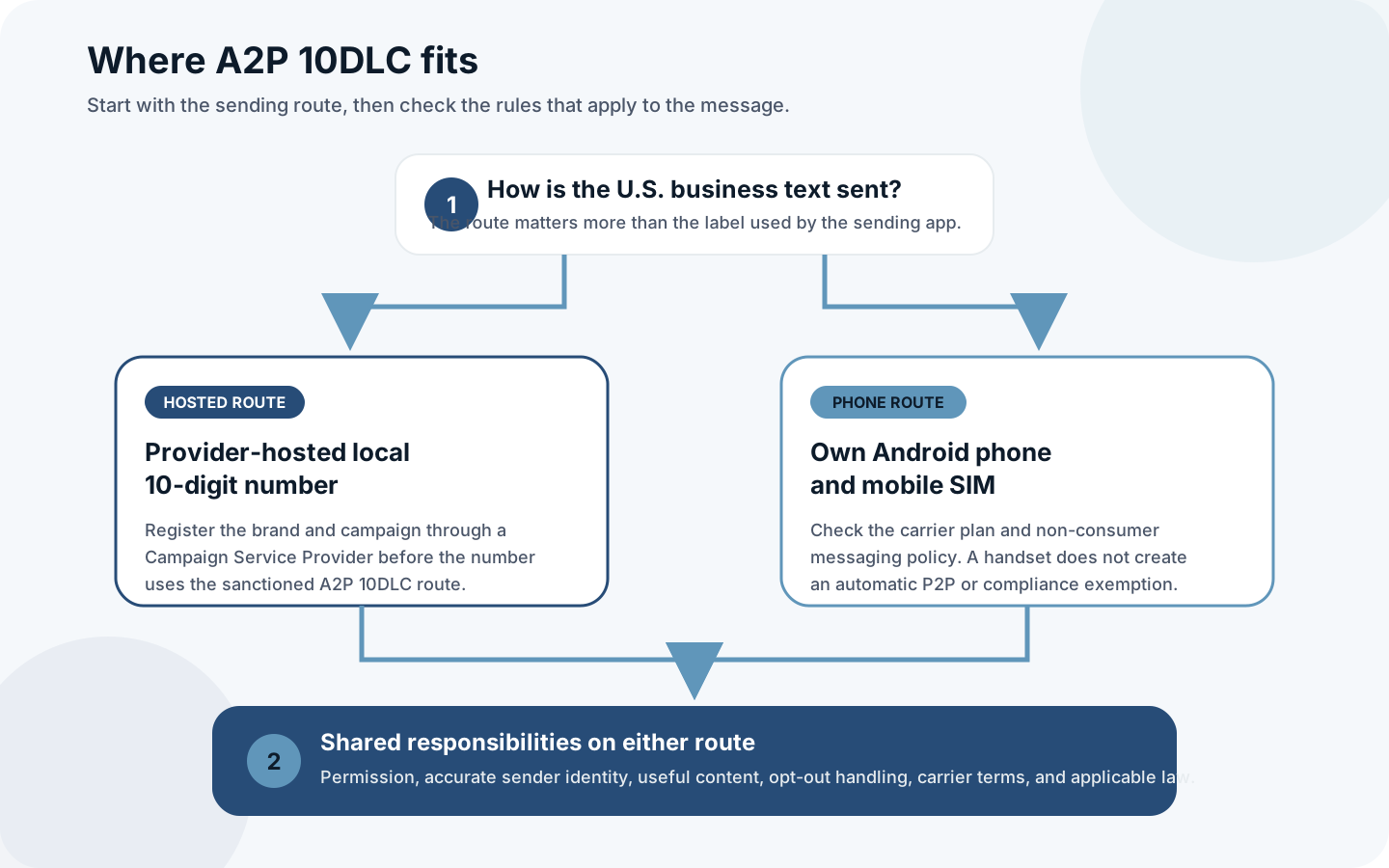
A2P means application-to-person, and 10DLC means 10-digit long code. In plain English, A2P 10DLC is the U.S. carrier route used when a business sends texts through a provider-hosted local 10-digit number.
On that route, the business supplies its identity and messaging use case. Its provider then registers the brand and campaign with The Campaign Registry, as described in TCR’s official 10DLC introduction.
The practical question is simple: are you using a messaging platform’s U.S. local number for customer or employee texts? If yes, registration is part of activating that route.
A2P 10DLC in a nutshell
- A2P 10DLC is a carrier-industry messaging route for business texts sent through U.S. local 10-digit numbers.
- Any business using that route for customer or employee messages is required by the 10DLC program to register, even when it sends messages one at a time.
- The business normally registers through its messaging provider, not directly with The Campaign Registry.
- Registration tells carriers which business is sending and what type of messages recipients should expect.
- Customer-facing costs can include brand or vetting work, campaign registration, a number or platform charge, message charges, and carrier fees.
Building an operational workflow rather than a hosted-number campaign? Start with the verified VoxiSMS integrations and compare the sending route before choosing a platform.
Start here: does A2P 10DLC apply to you?
The Campaign Registry’s guide says any business that wants to use SMS on 10DLC to communicate with customers or employees must register. That includes marketing campaigns, mass texts, account updates, customer support, and individual business messages. The requirement comes from the U.S. mobile-carrier 10DLC program; it is not a federal statute.
| Your SMS setup | Does A2P 10DLC registration apply? | What to do |
|---|---|---|
| Your business rents or receives a U.S. local 10-digit number from a messaging provider | Yes, for business texts sent on the 10DLC route | Complete brand and campaign registration through that provider |
| An employee sends a personal text to another person from a personal phone | No, this is not a business campaign on the A2P 10DLC route | No 10DLC campaign registration |
| Your business sends through its own Android phone, SIM, and mobile plan | This is a different route from a provider-hosted 10DLC number | Confirm that the carrier plan and business-messaging policy fit the use |
| Your provider uses a toll-free number or short code | No, not as 10DLC | Follow the separate verification or registration process for that number type |
The key is the route, not the size of the company. A dental practice sending ten reminders and a retailer sending thousands of order updates both need registration if those messages travel through provider-hosted U.S. 10DLC numbers.
Practical A2P 10DLC examples
Businesses do not register every individual text. They register the business, then describe the recurring messaging program, or campaign, that the number will support.
| Business use case | Example message |
|---|---|
| Appointment reminders | “Clinic name: Your appointment is Tuesday at 3:30 PM. Reply C to confirm or call us to reschedule.” |
| Order and delivery updates | “Store name: Order 4821 has shipped. Track it here: [tracking link].” |
| Field-service arrivals | “Service team: Your technician is due between 2:00 and 3:00 PM. Reply if access details have changed.” |
| Customer support | “Support team: Case 7314 has been updated. Reply to continue this conversation.” |
| Promotional offers | “Store name: This week’s subscriber offer is now available. Reply STOP to opt out.” |
During registration, the provider will also ask who receives these messages, what triggers them, how people provide their number, and whether replies are supported.
For example, a clinic with one local provider number would normally register its legal business as the brand and its appointment-reminder program as a campaign. It can then assign the sending number to that campaign through its provider. It does not create a new registration for every patient or appointment.
The provider chooses the formal campaign category with the business. The Campaign Registry gives “Marketing” and “Customer Care” as examples and advises brands to work with their provider when selecting the closest use case.
Why businesses register
Registration is not an optional certificate to add after launch. It is the provisioning step for business messaging on the U.S. 10DLC route.
Carriers use the registration to see the business behind the traffic and the type of messages it intends to send. The Campaign Registry says this visibility lets carriers offer a more reliable and predictable messaging service, while the campaign data determines the delivery terms available to the brand.
Businesses choose 10DLC when they want a provider-hosted local U.S. number for use cases such as reminders, account updates, customer care, and promotions. A 10DLC number can also support voice calls, which may be useful when customers need to call the same number they see in a text.
Without the required registration, the provider cannot treat the campaign as registered 10DLC traffic. That is why the first question for a hosted local number should be “How do we register?”, not “Can we skip it?”
Where businesses register and example providers
Most businesses do not create an account at The Campaign Registry. They enter their business and campaign details in their messaging provider’s dashboard or work with the provider’s onboarding team. The provider, acting as a Campaign Service Provider (CSP), submits the registration to TCR.
The wording of each provider’s dashboard differs, but the path is usually described as A2P 10DLC, U.S. messaging compliance, brand registration, or campaign registration.
| Example Campaign Service Provider | Where the business starts |
|---|---|
| Twilio | The provider’s A2P 10DLC registration workflow |
| Bandwidth | The provider account or onboarding team |
| Sinch | The provider account or onboarding team |
| Telnyx | The provider’s A2P 10DLC registration workflow |
All four appear on The Campaign Registry’s current list of participating CSPs. The selected provider or its upstream registration partner submits the information to TCR. The participating list is much longer, so a business can also ask its existing SMS, CRM, contact-center, or communications provider whether it is a registered CSP or a reseller working through one.
If a software platform is a reseller, the experience can look the same to the business: the platform collects the information, then an upstream CSP completes the TCR submission. Ask who owns the registration, where rejection feedback appears, and whether the registration can be transferred if the business changes providers.
How 10DLC registration works
For a business using a provider-hosted U.S. local number, the process usually has five steps.
- Choose the provider and number. Confirm that the business will send through a U.S. local 10-digit number on the provider’s A2P 10DLC route.
- Register the brand. Supply the legal business name, entity type, contact details, address, and EIN or other applicable tax identity. Sole proprietors follow a separate identity path.
- Describe the campaign. Explain what triggers a message, who receives it, how the recipient asked for it, and whether replies are supported.
- Provide real sample messages. Use examples that match the live workflow and identify the sender. The official TCR campaign-creation documentation includes campaign-use fields, sample messages, opt-in details, help and opt-out keywords, and related links.
- Submit and connect the number. The provider and its upstream partners review the campaign, return any corrections, and provision the number after approval.
Here is a useful appointment-reminder description a clinic could adapt:
Appointment reminders for existing patients who provide a mobile number when booking. Messages identify the clinic, include the appointment date and time, and let the patient confirm or contact the clinic to reschedule. Message frequency depends on the patient’s bookings.
Registration details need to match the live messaging program. A campaign described as account notifications should not quietly become a promotional list, and sample messages should reflect what recipients will actually receive.
How A2P 10DLC costs work
There is no single universal customer price for 10DLC. A business buys the route through a provider, and that provider may bundle or pass through several cost layers.
| Cost layer | What it covers | What to confirm |
|---|---|---|
| Brand registration and vetting | Identity verification and any additional review | Is this one-time, recurring, or included in the provider plan? |
| Campaign registration | Creating the declared use case in the registry | Is there a setup fee, and does a rejected or resubmitted campaign cost more? |
| Campaign or number rental | Keeping the campaign and local number active | Which charges recur each month? |
| Message and carrier charges | Provider usage rates and network pass-through fees | Is the quoted rate per message or per SMS segment, and which carrier fees are separate? |
| Operational work | Message review, opt-out handling, monitoring, and changes | Who owns each task after launch? |
The TCR developer documentation confirms that active campaigns incur recurring registry charges paid by the provider. That does not establish the final price every provider charges a business. Some providers pass fees through, while others bundle part of the cost into a plan.
Before comparing providers, ask for the total first-month cost, the ongoing monthly cost, the per-segment rate, and the price of changes or re-vetting. A low headline rate says little when it omits registration, number, campaign, or carrier costs.
A provider-hosted number and an Android SIM are different routes
An Android phone with its own SIM does not use a provider-hosted 10DLC number by default. That is a different sending route, so the hosted-number registration steps above are not the setup process for the phone itself.
The device alone does not determine how a carrier treats business messaging. T-Mobile’s current consumer versus non-consumer messaging policy, for example, distinguishes direct texts between individuals from non-consumer traffic such as account notifications. Businesses using an own-phone route should therefore check the carrier plan and intended message type rather than treating the handset as a universal exemption.
Where VoxiSMS fits
VoxiSMS sends through the Android phone, SIM, real mobile number, and carrier plan that the business connects. It does not rent a U.S. 10DLC number or register campaigns as a Campaign Service Provider.
The model fits operational workflows such as reminders, order updates, service confirmations, and internal notifications. VoxiSMS adds no separate per-message fee; messages use the connected mobile plan.
Want to test the device-based route with an internal contact? Install VoxiSMS from Google Play, connect an active Android phone and SIM, and start with an operational workflow.
Registration and permission answer different questions
Registration answers the carrier’s “who is sending and for what purpose?” questions. It does not prove that every recipient agreed to every message.
The practical permission record is separate from the route registration. Use the SMS opt-in examples and checklist to define the message purpose, save the agreement, and connect opt-outs to the sending workflow.
For covered U.S. calls and texts, the current FCC rule in 47 CFR 64.1200 sets consent and revocation requirements based on the message and technology used. CTIA’s Messaging Principles update likewise tells non-consumer senders to obtain consent before messaging and honor opt-out requests.
In practice, keep the sender identity clear, use the number for the campaign described during registration, and make opt-out handling part of the workflow. Those are operating requirements, not benefits supplied automatically by registration.
Choose the route that matches the program
| Situation | Route to evaluate | Main question |
|---|---|---|
| A business sends through a provider-hosted U.S. local number | Registered A2P 10DLC | Which brand, campaign, fees, and provider review apply? |
| A team sends operational texts through its own Android phone and SIM | Own-device mobile route | Does the carrier plan fit the use, and is the recipient expecting this message? |
| A business needs broad promotions or high-throughput U.S. delivery | A sanctioned high-volume provider route | Which registration, permission, opt-out, and monitoring controls are built for the program? |
The workflow tool can be chosen after the route. Teams can connect app events through the verified VoxiSMS Zapier integration, build visual scenarios with the VoxiSMS Make integration, or send appointment communication through the VoxiSMS and Voxiplan integration. In each case, the connected Android phone remains the sender.
When a provider says it “handles 10DLC,” ask who submits the brand, creates the campaign, returns rejection feedback, and charges the recurring fees. That answer reveals how much work remains with the business.
Frequently asked questions
Who is required to register for A2P 10DLC?
Any business using SMS on a U.S. 10DLC route to communicate with customers or employees is required by the carrier program to register its brand and campaign. The TCR guide says this includes individual business messages, not only mass marketing.
Can a business register directly with The Campaign Registry?
Usually no. The Campaign Registry says a business using SMS is a Brand and should work through a Campaign Service Provider, which submits the brand and campaign registration and coordinates the messaging route.
Do I register every message or customer?
No. The brand represents the business, and the campaign describes a recurring use case such as appointment reminders or customer care. The provider then associates one or more sending numbers with that approved campaign.
Does one-to-one business texting need registration?
Yes, when the message travels through a provider-hosted 10DLC number. TCR explicitly includes individual business messages in the registration requirement. A personal text between consumers is different.
Which provider should I register with?
Start with the provider that supplies the U.S. local number. Twilio, Bandwidth, Sinch, and Telnyx are examples on TCR’s participating CSP list, but many CRM and communications platforms collect the same information as resellers. Ask where the registration lives, what fees recur, and who handles corrections.
Does an Android phone automatically avoid A2P 10DLC?
An Android phone and SIM are not a provider-hosted 10DLC route by default, so the provider registration process described here is not how the phone is activated. The carrier plan and business-messaging policy still determine whether the intended use fits that mobile route.
Compare the available workflow connections on the VoxiSMS integrations page, then choose the sending route that matches the number, provider, and message type.
