


SMS and MMS are carrier messaging formats built for different jobs. SMS sends short text and works well for reminders, status updates, and links; MMS extends that channel with pictures, video, audio, or attachments. For a business, the practical choice depends on the information the recipient needs, carrier support, and how the sending tool handles each format.
VoxiSMS sends SMS only. That makes this comparison especially useful when deciding whether an operational message can stay text-first or genuinely needs a richer messaging service.
SMS vs MMS in a nutshell
- SMS is for short text, numbers, and links. The FCC describes it as short text messaging, typically 160 characters or fewer.
- MMS extends SMS with media such as pictures, video, and attachments.
- A text-first reminder, confirmation, or status update usually fits SMS.
- Use MMS when the image or file must arrive inside the message, not when a link can carry the extra detail.
- Carrier support, message encoding, attachment limits, and the sending tool can all change the final cost.
Building a text-first workflow? Start with the VoxiSMS integrations directory and choose the system that already holds the business event.
The practical difference between SMS and MMS
The FCC’s definitions provide a useful baseline: SMS enables short text messages, while MMS is an extension of SMS that can deliver media such as pictures, videos, and attachments. Those definitions appear together in the agency’s guide to its SMS and MMS rules.
| Decision point | SMS | MMS |
|---|---|---|
| Message content | Text, numbers, and links | Text plus pictures, video, audio, or attachments |
| Strong business fit | Reminders, confirmations, status changes, short instructions, reply prompts | Visual proof, product imagery, media-led instructions, or an attachment the recipient needs immediately |
| Format constraints | Text length and character encoding affect how the message is segmented | Carrier and provider support, data access, and attachment limits affect the send |
| Group behavior | Replies can return as separate individual texts | Group MMS can keep participants and replies in one conversation |
| VoxiSMS support | Supported | Not supported |
Do not identify the format by bubble color alone. Apple’s Messages app supports iMessage, RCS, SMS, and MMS, while Google Messages labels the active route as RCS, SMS, or MMS. Google’s RCS documentation explains that SMS and MMS still travel through the carrier even when RCS is enabled.
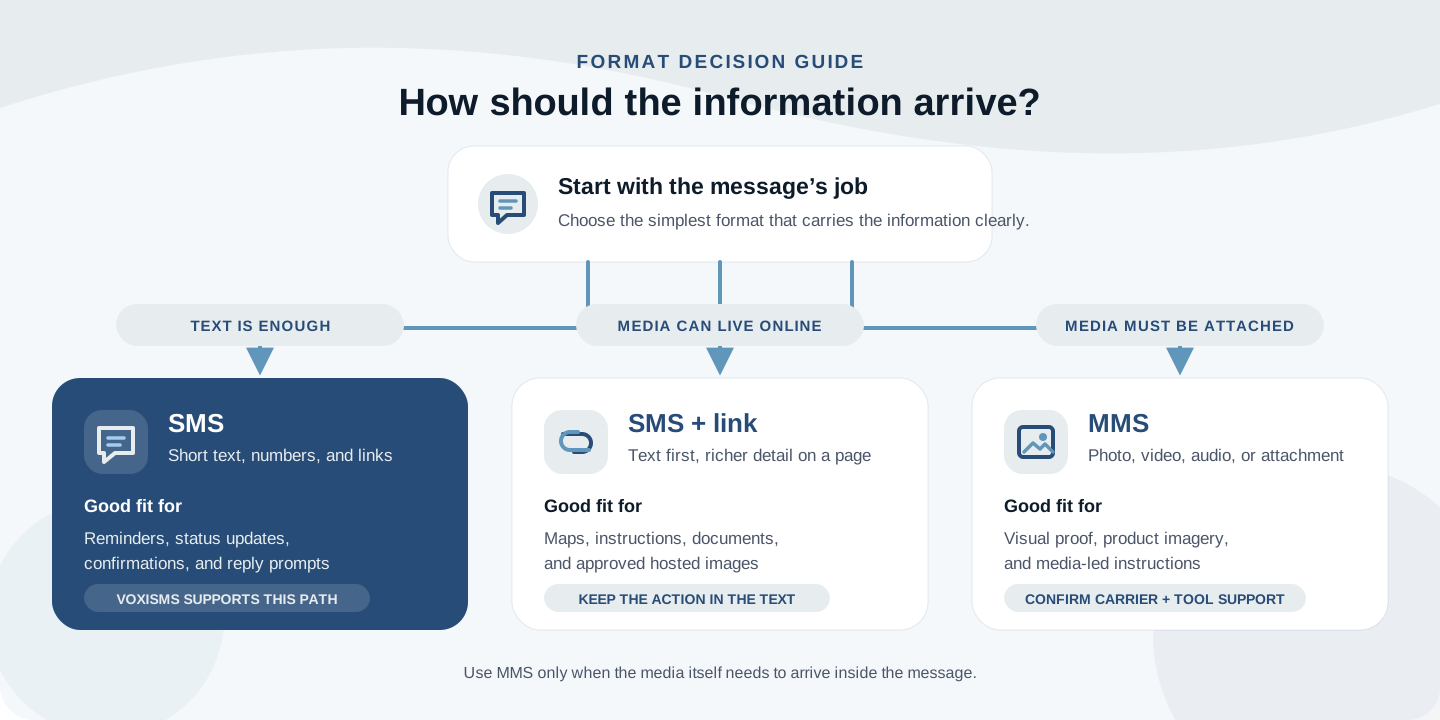
Choose SMS for action-first business messages
SMS is usually the simpler choice when the message can be understood and acted on as text. The format keeps the business event, next step, and reply path in one compact message.
| Business event | SMS example |
|---|---|
| Appointment reminder | “[Business]: Reminder for [service] on [date] at [time]. Reply C to confirm or call [number] to change it.” |
| Order ready | “[Business]: Order [reference] is ready for collection at [location]. Reply if you need help.” |
| Delivery status | “[Business]: Delivery [reference] is scheduled for [window]. Track or update it at [approved link].” |
| New enquiry | “[Business]: We received your request about [topic]. Reply with a suitable time, or choose one at [approved link].” |
| Service update | “[Business]: Work at [location/reference] is complete. Details: [approved link]. Reply if anything needs attention.” |
| Internal notification | “[System/location]: [event] needs review. Open [approved link] and reply when checked.” |
These examples keep one useful action in each message. They also leave the rich detail in the source system, where it can be corrected without sending another attachment.
SMS character limits and encoding
The familiar 160-character limit applies to the GSM default 7-bit alphabet. A 3GPP specification also defines a 70-character limit for a message using 16-bit UCS2 encoding. Accented characters, non-Latin scripts, and some symbols can therefore change the number of segments used for the same visible sentence.
Write the message with real names, references, and links before testing it. A short placeholder can fit one segment while the populated version becomes longer. Check the final text on the actual sending route instead of assuming that every character is counted the same way.
Choose MMS when the media carries the meaning
MMS earns its place when a photo, video, audio clip, or attachment is part of the task. A field-service completion photo, a product image that prevents a collection mistake, or a visual instruction can communicate something that plain text cannot.

Before choosing MMS, confirm that the carrier plan and messaging tool support it. Apple’s current support guidance says SMS and MMS are carrier-provided services and require a compatible messaging plan. Apple also notes that carriers may set attachment-size limits and that a device may compress larger photos or videos.
MMS can also change the shape of a group conversation. Apple’s group messaging guide says group SMS sends replies back as individual texts, while group MMS allows participants to see responses in the shared conversation. That difference matters for team coordination, but it can also expose replies to everyone in the group, so choose the conversation model deliberately.
When an SMS link is enough
A link can keep the immediate action in SMS while moving richer material to a page your business controls. This works well for:
- a map or route that may change;
- a document with a newer approved version;
- a hosted image attached to a service record;
- detailed instructions that would be awkward in a text;
- an order, booking, or support page with the latest status.
Make the text useful even before the recipient opens the link. Name the business, state what changed, and explain what the destination contains.
What SMS and MMS can cost
There is no useful universal price for either format. The amount depends on the carrier plan, country, roaming state, message encoding, provider, automation platform, and whether a long text is treated as multiple SMS segments. MMS can have separate plan treatment and attachment rules.
| Cost factor | What to check |
|---|---|
| Carrier plan | Whether SMS and MMS are included, charged separately, or restricted for business use |
| SMS encoding | Whether the final text uses the default alphabet or a Unicode encoding that changes segment length |
| Message length | Whether the populated text becomes more than one segment |
| MMS data and size | Whether mobile data is required and how the carrier handles larger attachments |
| Automation platform | Subscription or task costs for the trigger and workflow |
| Messaging provider | Any per-message, media, number, registration, or account fees attached to its route |
Compare the full path rather than a single headline rate. A message format that looks inexpensive can create extra cost if the tool splits it, the attachment is rejected, or staff must resend the information another way.
Where VoxiSMS fits
VoxiSMS turns an Android phone, SIM, and real mobile number into the SMS delivery step for a business workflow. The connected system supplies the trigger and message fields, and the phone sends the text through its active carrier plan. VoxiSMS adds no per-message fee; the mobile plan remains the source of any carrier charges or restrictions.
Use the VoxiSMS Zapier integration when an event in another app should trigger the text. Choose the VoxiSMS Make integration for visual scenarios with filters and mapped fields. For appointment confirmations, reminders, cancellations, and reply routing, use the VoxiSMS and Voxiplan integration.
Because VoxiSMS sends SMS only, use a concise text and an approved hosted link when the richer material can live online. If the recipient must receive an image, video, audio file, or attachment inside the message, choose a verified MMS-capable service for that workflow.
Ready to test the SMS path? Install VoxiSMS from Google Play, connect your Android phone, and begin with an internal recipient.
A five-point format check
Use these questions before building the automation:
- Can the recipient understand the update and next action from text alone?
- If richer detail is needed, can an approved hosted link carry it?
- Does the image, video, audio, or attachment have to arrive inside the message?
- Does the carrier plan and sending tool support the chosen format for the destination?
- Has the populated message been tested with its real characters, links, and reply path?
My recommendation is to start with SMS for operational messages and move to MMS only when the media is essential to the task. That keeps the workflow easier to test and makes the format decision depend on the message, not decoration.
